Profile
About Me
I am pursuing a Master of Science in Electrical Engineering at California Polytechnic State University, San Luis Obispo. My work centers on embedded systems, machine learning, and signal processing. My master's thesis explores machine-learning models that use satellite imagery and sensor-network data to predict coastal water metrics.
Selected engineering work
Projects
Ongoing thesis research in coastal machine learning, embedded sensing systems, computer vision, power electronics, and conservation technology.
Embedded systems / Wireless sensing
Aquasense
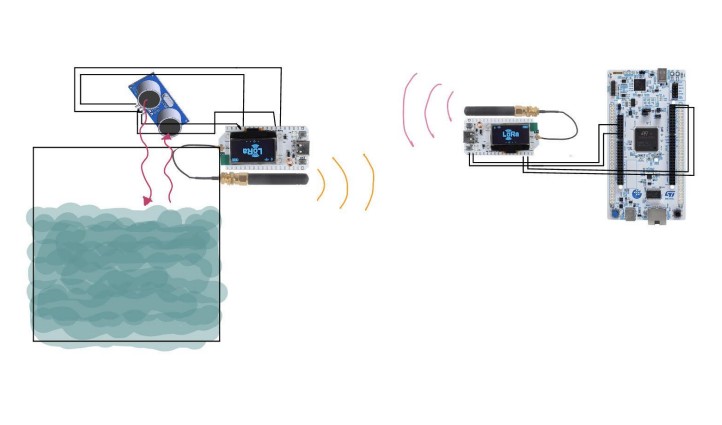
Aquasense is a remote water-level monitoring system I developed to measure potable-water cistern levels and tidal changes. The system uses embedded microcontrollers, ultrasonic sensing, and long-range LoRa communication. It includes an STM32 Nucleo interface, a remote ESP32 sensing node connected to an HC-SR04 ultrasonic sensor, and an ESP32 base-station receiver. Users configure operating modes and tank parameters through a 4×3 keypad. The remote node transmits measurements over a 915 MHz LoRa link, and the base station displays live water levels and user inputs on an OLED. The project involved STM32 and ESP32 firmware development in C and C++, I²C peripheral integration, keypad debouncing and scanning, LoRa networking, system integration, and hardware configuration.
- Developed a remote water level sensing system using STM32 and two ESP32s for water level monitoring.
- Designed and troubleshot low-level I²C communication between the STM32 and ESP32s.
- Integrated HC-SR04 ultrasonic sensor with remote ESP32 for water level measurement.
- Designed the LoRa wireless link and tested communication at distances up to 9 miles in field conditions.
- Added keypad scanning, debouncing, and user input scripts to the system.
- Developed firmware that converts ultrasonic time-of-flight readings into water-level measurements and displays the results on an OLED.
Computer vision / Image processing
Rock Paper Scissors Detection
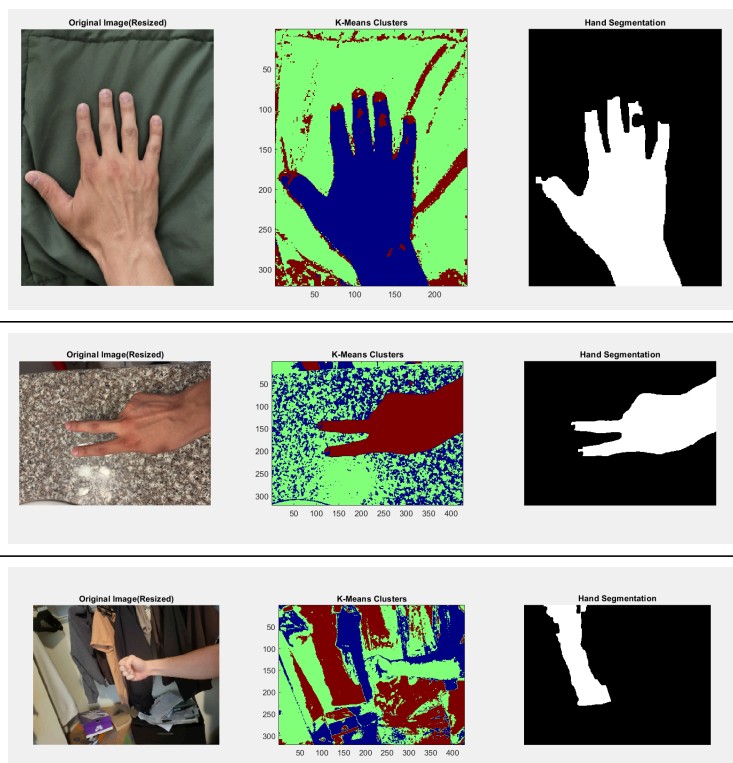
This project addresses the challenge of recognizing hand gestures in cluttered indoor and outdoor environments. The system combines color-space analysis, image segmentation, feature extraction, and geometric classification to identify rock, paper, and scissors gestures as background texture, color, and hand orientation change. It also compares the reliability of multiple segmentation and shape-classification algorithms in conditions where simple template matching fails.
- Analyzed HSV and YCbCr color spaces and optimized segmentation parameters to improve hand detection.
- Implemented K-means clustering and masking to separate hands from cluttered indoor and outdoor backgrounds.
- Used binary boundary tracing to extract object contours from segmented images.
- Extracted geometric descriptors—including solidity, eccentricity, compactness, extent, aspect ratio, and radial signature—to classify hand shapes using conditional thresholds.
- Evaluated segmentation and classification across four outdoor and four indoor environments, totaling 96 samples, with 100% classification accuracy.
- Analyzed variations in lighting, background texture, hand orientation, and finger positioning for each gesture.
M.S. thesis research / Machine learning / Coastal sensing — In progress
Coastal Turbidity and Chlorophyll Predictions Using Machine Learning
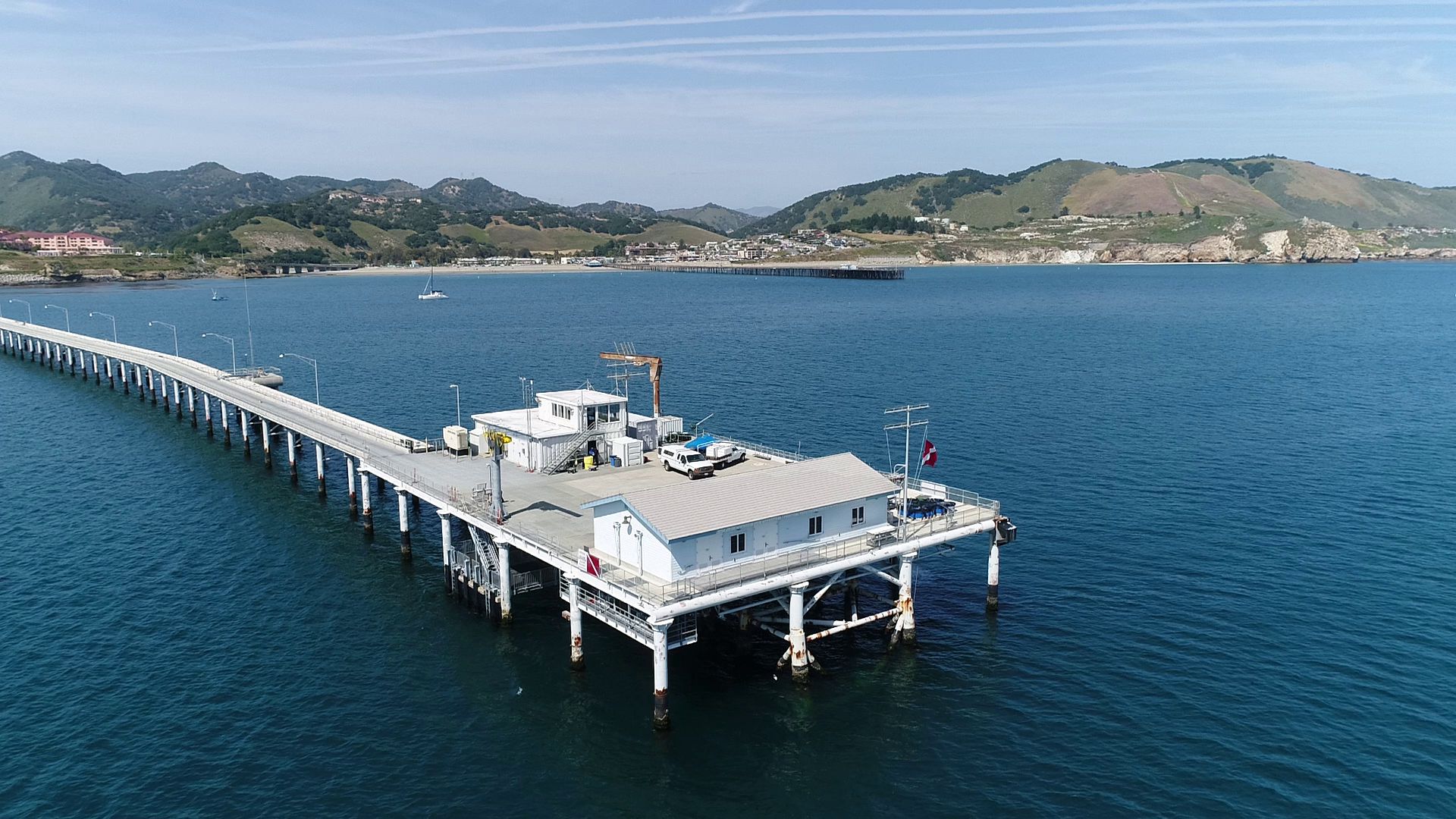
My ongoing master's thesis uses a nested experimental design to compare various machine-learning models for predicting coastal chlorophyll and turbidity. Each model is evaluated across different training and testing splits. These splits include satellite-derived features alone, satellite features combined with local environmental forcing features, and local environmental forcing features alone. My current results indicate that the combined satellite and environmental models perform the best because local environmental features provide context about nearshore conditions that satellite inputs alone do not capture.
- Built a dataset spanning five years (2020–2024) using multiple sources, with in-situ water-quality observations, Sentinel-3 products, and local environmental and swell measurements. The dataset is time-aligned at each data point in 30-minute intervals.
- Standardized data from various sampling frequencies by converting variables to consistent numeric formats, tracking satellite-observation age, and excluding rows in the dataset with any missing data points.
- Designed and implemented Random Forrest, XGBoost, and Feedforward Neural Network ML models for separate chlorophyll and turbidity prediction tasks.
- Compared randomized testing training splits and held-out day, year, and month models for a range of predictive quality interpretations.
- Performed comparisons between models using satellite-only inputs and satellite inputs augmented with environmental and swell forcing variables.
- Evaluated each model and experiment using R², mean absolute error, root mean squared error, prediction bias, and train–test performance gaps.
Power electronics / Control systems
DC-AC Voltage Source Converter
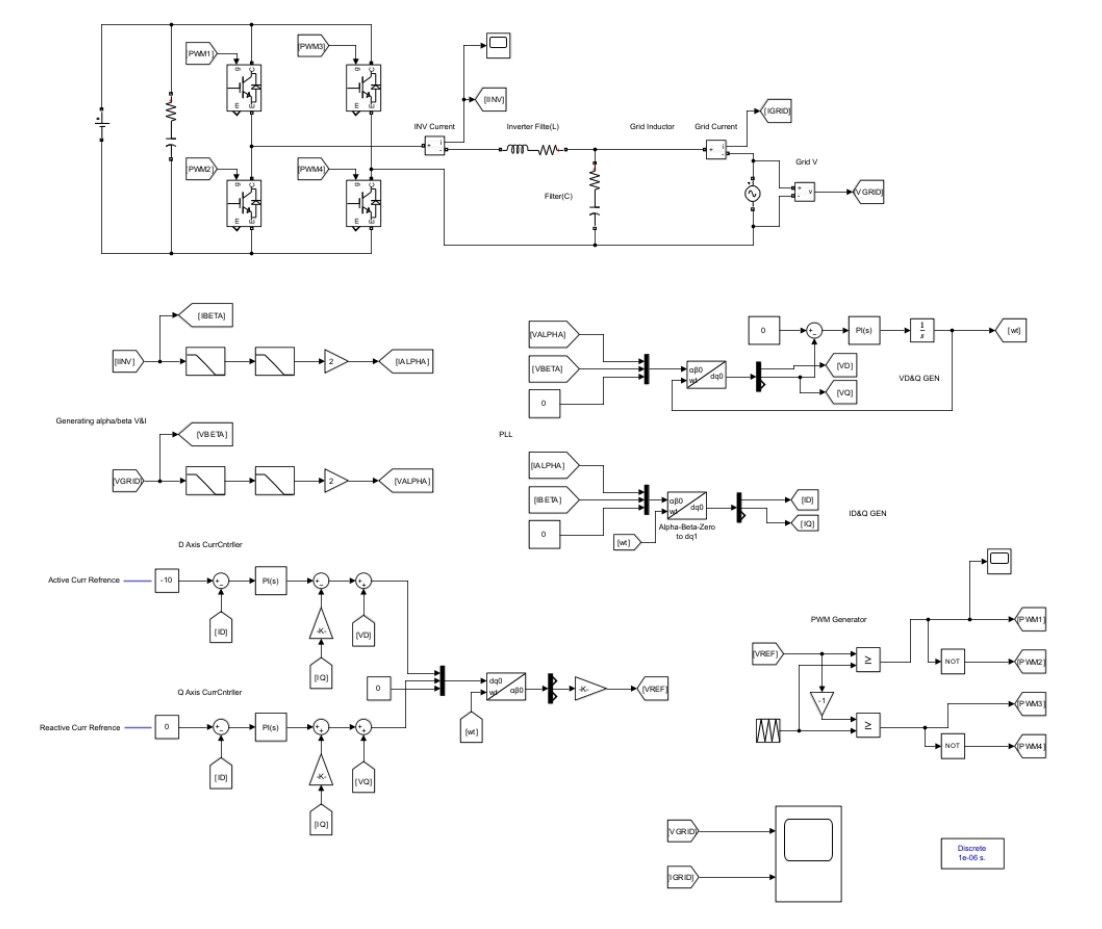
A senior design project covering requirements, converter simulation, software development, hardware integration, and validation of a controlled DC-to-AC power conversion platform. The work uses detailed simulation and control logic to shape DC input into regulated AC output while tracking switching dynamics and power-stage performance. The project adds documentation and verification for a full-system hardware-in-the-loop workflow.
- Modeled DC-AC converter behavior and switching dynamics in simulation.
- Developed control logic for regulated AC output from a DC source.
- Validated power-stage functionality through simulation results and hardware testing.
- Documented requirements, design tradeoffs, implementation, and verification workflow.
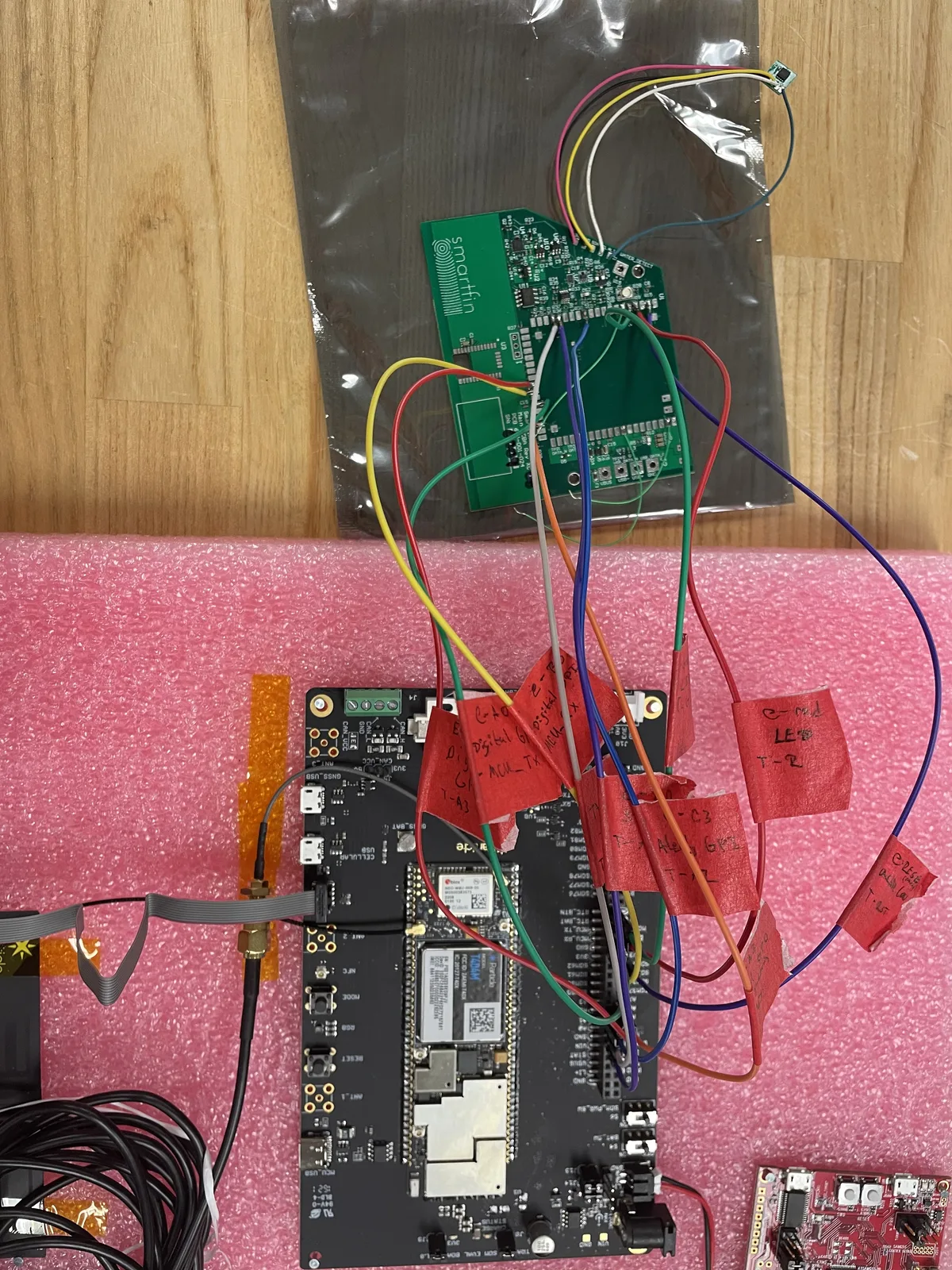
Research internship / Electronics and marine sensing / UC San Diego
SmartFin — Engineers for Exploration
During this internship, I designed an embedded sensing platform for coastal data monitoring. The device transforms surfers into mobile data-collection platforms in the surf zone, where traditional coastal monitoring is difficult. It integrates temperature, salinity, wet/dry, and accelerometer sensors into a robust mobile sensing system.
- Created a PCB in Altium Designer to interface environmental sensors, power management, wireless communications, and status LEDs with an ESP32 microcontroller.
- Measured temperature, salinity, wet/dry state, and acceleration across the x, y, and z axes.
- Integrated ESP32 peripherals through SPI, I²C, and GPIO interfaces for data acquisition.
- Validated individual PCB circuits through hardware-in-the-loop testing before board fabrication.
- Uploaded firmware and tested each sensor before waterproofing and potting the circuitry inside a surfboard fin.
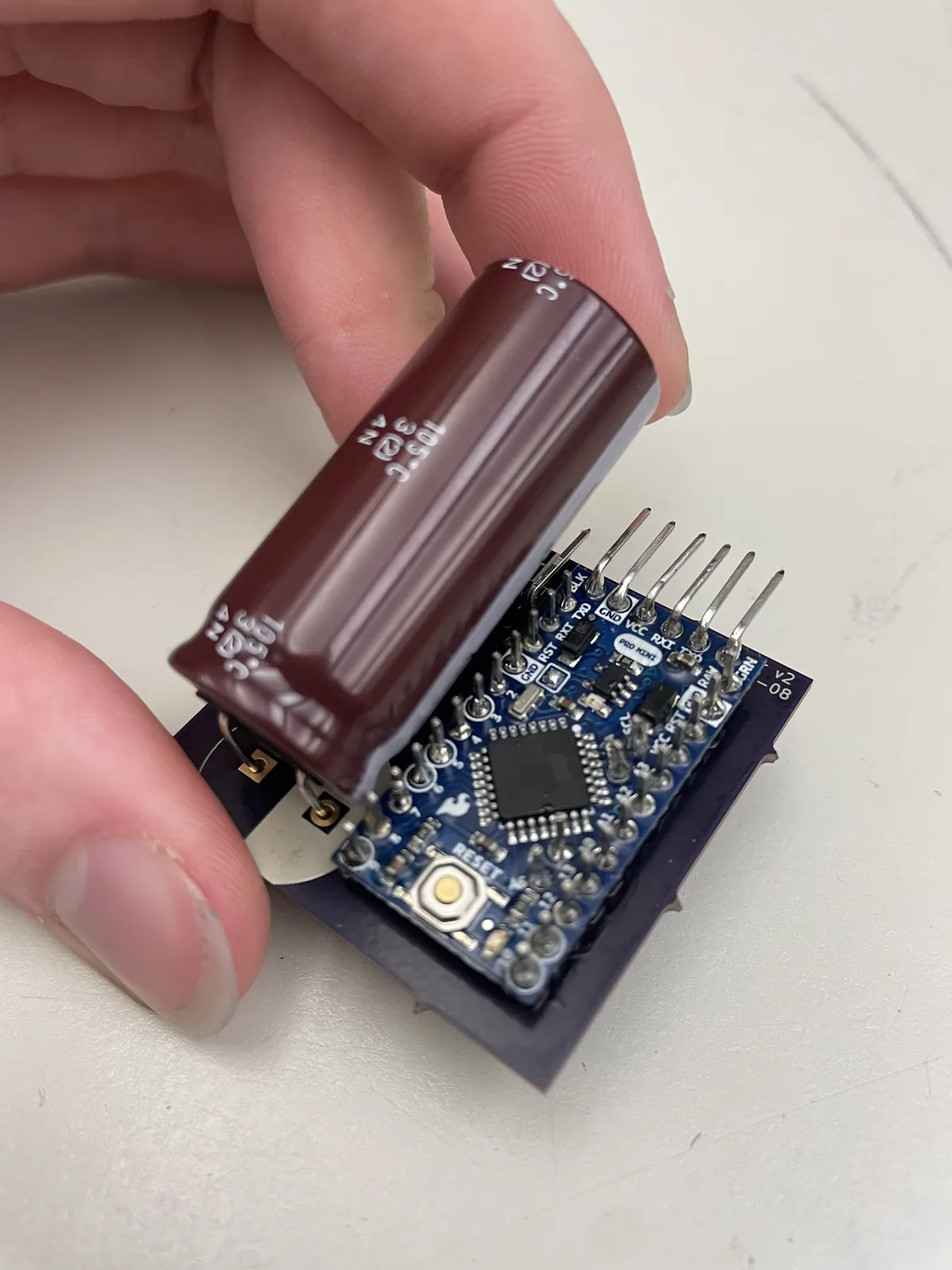
Conservation research
Whale Detangler Device
Designed an embedded sensing and data-logging device to support whale-detangling efforts involving commercial crabbing lines off the California coast. The system integrates motion sensing, force detection, data storage, power management, and a line-cutting circuit into a compact PCB.
Acknowledgement: Research grant (US$3,000) from the Los Angeles Cetacean Society (2024).
- Integrated an Arduino Pro Mini with a custom PCB containing an ADXL363 accelerometer, SPI EEPROM, strain-gauge signal conditioning, power management, and capacitive line-cutting hardware.
- Designed a Wheatstone-bridge amplifier to convert strain-gauge measurements into quantifiable line-force data.
- Optimized the bridge and amplifier for low power consumption and capacitive line-cutting trigger activation.
- Bench-tested the accelerometer, EEPROM, strain sensing, power management, and capacitive trigger, verifying supply levels and motion-sensing signals.
- Validated the strain gauge by comparing known tensile loads with calculated sensor output.
- Presented the results to the Los Angeles Cetacean Society after completing the grant-supported research.
Documents
Resume & C.V.
Open either document in a new tab for full-screen viewing, or download a copy directly.
Professional Resume
Focused engineering experience, technical skills, education, and selected research.
Curriculum Vitae
Academic background, research focus, projects, presentations, and professional experience.
Electrical Engineering Skills
These tools serve as the foundation for my work in sensor design and integration, machine learning system modeling, and object recognition.